Quick answer
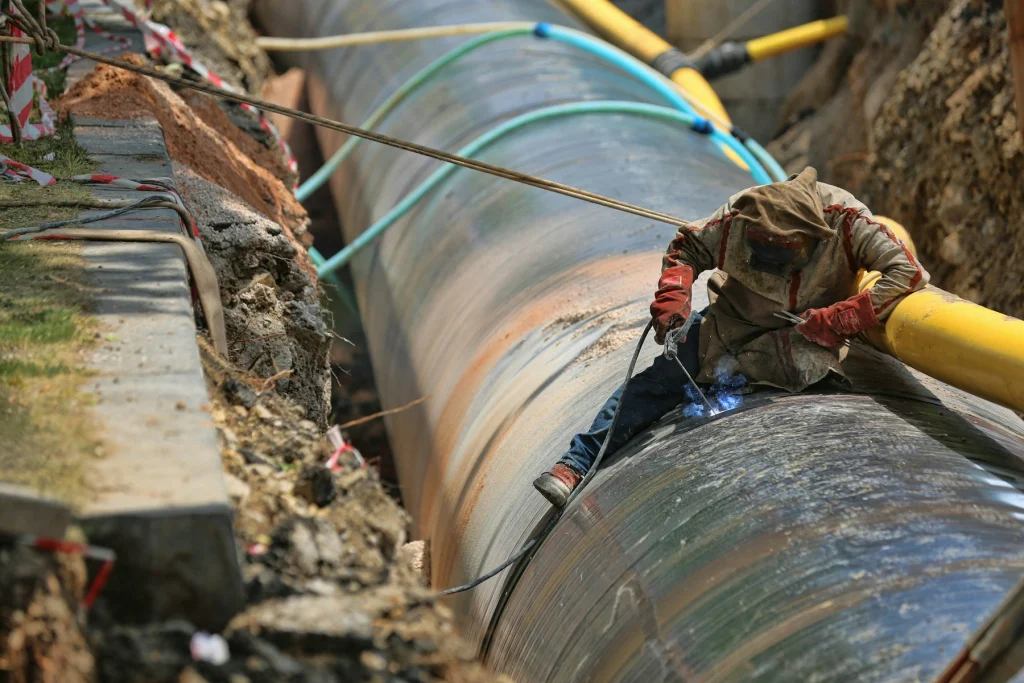
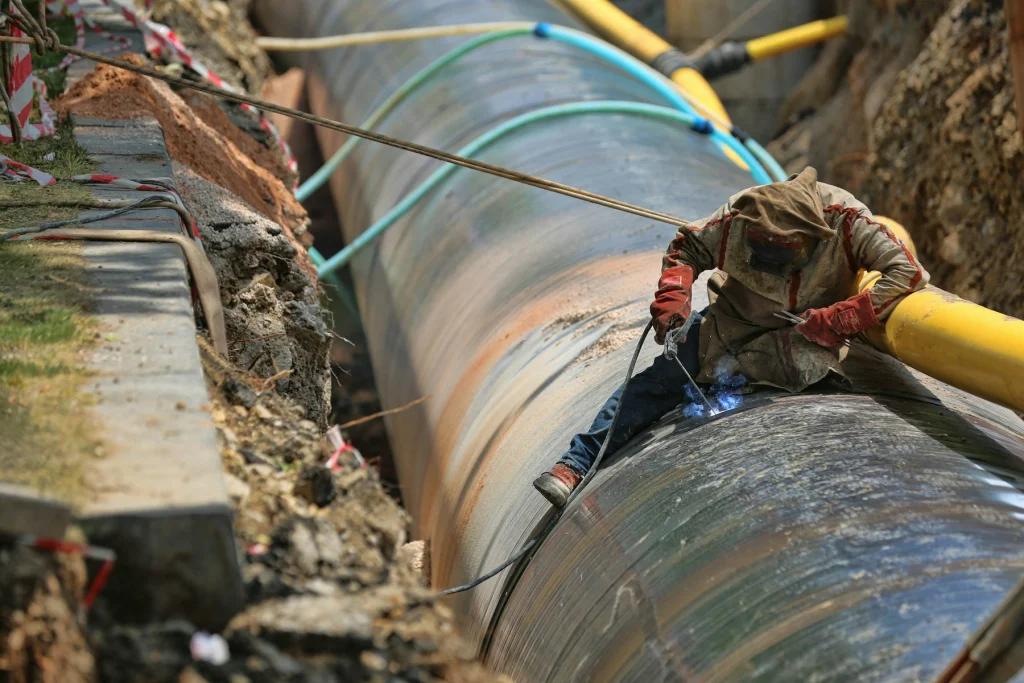
Industrial pipe welding joins carbon steel, stainless and alloy pipe for process, steam, air, water and utility systems in plants. We weld to the governing code, most often ASME B31.3 or B31.1, using qualified procedures and welders, fabricate spools in the shop to shorten outages, and coordinate examination and pressure testing before lines return to service.
Key points
Carbon steel, stainless and chrome-moly pipe in butt, socket and branch connections
Procedures and welder qualifications matched to the governing piping code
Shop spool fabrication measured to field conditions
Examination and hydrostatic or pneumatic testing coordinated with your inspector
Supports, shoes, guides and hangers fabricated with the piping
Process, utility and support piping: what we weld
Our pipe work falls into three groups. Process piping carries hydrocarbons, chemicals, slurries and product streams and is usually the most heavily specified. Utility piping covers steam, condensate, compressed air, nitrogen, cooling water and fire water. The third group is the structure that holds it all up: shoes, guides, anchors, trunnions and hanger steel.
Common materials include ASTM A106 Grade B and A53 carbon steel, A312 TP304L and TP316L stainless, and chrome-moly grades such as P11 and P22 for high-temperature service. Joints are mostly full-penetration butt welds, socket welds on small bore lines and branch connections using reinforced fittings or integrally reinforced outlets.
Sizes range from small bore instrument and drain connections to large headers. The procedure, not the diameter, decides how hard a job is: a thin-wall stainless line with a purge requirement can take longer per joint than a heavier carbon steel line. Where new nozzles or connections land on non-code tanks and hoppers, the work overlaps with our tank and vessel repair service.
ASME B31.3, B31.1 and Section IX in plain terms
Most plant piping is built to ASME B31.3 Process Piping. Steam and boiler external piping in power applications often falls under ASME B31.1 Power Piping, and cross-country pipelines use other standards such as API 1104. The piping code sets design rules, examination requirements and testing, while ASME Section IX defines how welding procedures and welders are qualified.
In practice that means each joint is made to a written welding procedure specification supported by a procedure qualification record, by a welder qualified for that process, position and material range. Owners frequently add their own requirements, such as hardness limits for sour service, extra examination on certain fluid classes or restrictions on specific filler metals.
Under B31.3, examination depends on fluid service category. Normal fluid service commonly calls for random radiographic or ultrasonic examination of a portion of butt welds, while severe cyclic or high-hazard services require more. Your specification controls, so we price examination after reading it rather than assuming.
Root, fill and cap: how a sound pipe joint is built
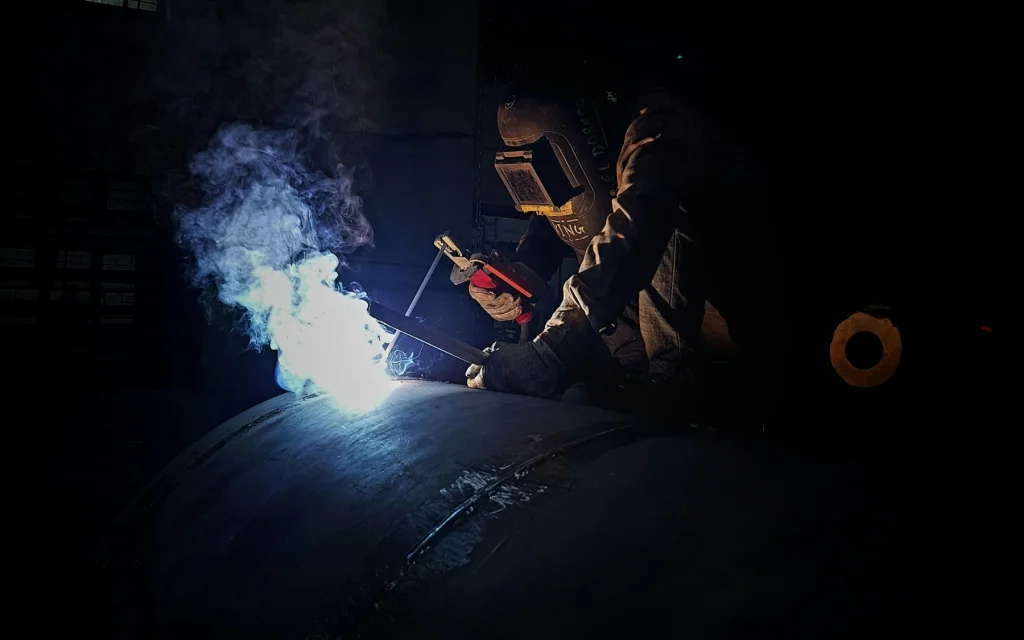
A pipe butt weld starts long before the arc. Ends are beveled, typically to about 37.5 degrees with a small land, cleaned to bright metal and fitted with a consistent root opening and minimal high-low misalignment. Poor fit-up is the most common root cause of rejected pipe welds, so we spend time here.
The root pass sets the quality of the whole joint. On carbon steel it is often run with an E6010 cellulosic electrode or with TIG; on stainless and alloy pipe, TIG with an argon back purge protects the inside of the root from oxidation. Hot pass, fill and cap passes follow, frequently with low-hydrogen E7018 electrodes or the filler specified in the procedure.
Between passes, the welder controls interpass temperature, cleans slag and checks profile. Preheat is applied and verified with temperature indicators where the procedure requires it, which is routine on thick carbon steel and mandatory on chrome-moly.
Bevel, land and root opening checked before tacking
Purge oxygen level verified on stainless and alloy roots
Preheat and interpass temperature measured, not estimated
Visual inspection of every pass before the next goes in
Carbon, stainless and chrome-moly considerations
Carbon steel is forgiving but not careless work. Low-hydrogen electrodes have to stay dry, which means rod ovens on site and discipline about how long electrodes sit exposed, particularly in humid regions such as the Houston Ship Channel.
Austenitic stainless grades need low heat input and controlled interpass temperature to protect corrosion resistance, plus clean tools that have not touched carbon steel. Chrome-moly pipe needs preheat, careful hydrogen control and often post-weld heat treatment by a qualified heat treater. We include heat treatment requirements in the quote whenever the specification calls for them.
Shop spool fabrication that shortens tie-in windows
Every weld made in the shop is one less weld made during the outage. Spools are cut, fitted and welded in rollable positions, examined and pressure tested where practical, then tagged and delivered ready for installation. Field work is reduced to the closure welds that tie new piping into existing lines.
Accuracy is the key risk. We work from isometrics and, for tie-ins, from field measurements taken on the actual line, often leaving a field fit weld with extra length so the crew can trim to as-found dimensions. That small allowance prevents a spool from arriving a few inches short in the middle of a turnaround.
Spools pair naturally with our structural steel scope when new racks or supports are needed for the same project.
How a pipe welding job works with Industrial Welding
01
Line list and specs
We review isometrics, piping class, material and examination requirements, and request missing details or field measurements before quoting.
02
Procedure confirmation
Applicable welding procedures and welder qualifications are matched to each material and joint type, and owner requirements are flagged.
03
Spool fabrication
Spools are cut, fitted, welded, examined and tagged in the shop, with field fit allowances where tie-in dimensions are uncertain.
04
Install, test, turnover
Field crews complete tie-ins under permit, support examination and pressure testing, and deliver weld maps and records at turnover.
Testing pipe welds before a line goes back in service
After welding and examination, new or repaired piping is normally pressure tested. Under B31.3 a hydrostatic test is typically performed at not less than 1.5 times design pressure, adjusted for temperature, while a pneumatic test, used only when water is not acceptable, is typically run at a lower multiple with stricter safety controls. Confirm the required test with your piping engineer.
Pneumatic testing stores far more energy than hydrostatic testing and needs exclusion zones and staged pressurization. Where neither is practical for a closure weld, owners sometimes accept alternative examination methods permitted by the code; that decision belongs to the owner and engineer, and we document whichever path is chosen.
What drives the price of an industrial pipe welding job?
The number of welds matters, but material, schedule, procedure and examination matter more. A short run of stainless with purge requirements and full radiography can cost more than a long carbon steel utility line. Field conditions add time: draining and purging the system, isolation, permit cycles, scaffold access and fire watch.
A useful quote request includes isometrics or a line list, the piping class, material grades, examination and test requirements, and your outage dates. If your job is part of a larger outage, our plant maintenance welding crews can carry it within the same shutdown plan.
Material grade, diameter and wall thickness
Number of field welds versus shop welds
Purge, preheat and post-weld heat treatment requirements
Examination percentage and pressure test method
Access, isolation and site safety requirements
Frequently asked questions
Do you weld to ASME B31.3?
Yes. Most of our plant piping work is performed to ASME B31.3 using welding procedures and welder qualifications under ASME Section IX. We also work to B31.1 and owner specifications. Tell us the governing code, piping class and any owner requirements, and the quote will list the procedures, examination and records included.
Can you weld stainless steel pipe?
Yes. Stainless pipe is usually welded with TIG for the root, using an argon back purge to protect the inside of the joint, and finished with TIG or a matching stick electrode. We control heat input and interpass temperature and use dedicated stainless tools to avoid contamination that could compromise corrosion resistance.
What is a pipe spool and why fabricate in the shop?
A spool is a prefabricated section of piping with fittings, flanges and branches already welded in place. Building spools in the shop allows rolled welds in good positions, easier inspection and testing before installation. During an outage, the field crew only makes the closure welds, which can shorten the time a system is out of service.
Who performs radiography or ultrasonic testing on pipe welds?
Examination required by the piping code or owner is normally performed by an independent nondestructive testing company. Depending on the contract, the owner or we hire that firm. We coordinate timing, provide weld maps that identify each joint, repair any rejected welds and support re-examination until the line is accepted.
Do you handle post-weld heat treatment?
When the specification requires post-weld heat treatment, such as on chrome-moly pipe or thick carbon steel, we arrange it through a qualified heat treating provider and include it in the quote. Charts and records from the treatment become part of the turnover package along with weld and examination records.
Can you repair a leaking process line?
Usually, once the line is isolated, drained, purged and released for hot work. We assess the cause, because a leak from corrosion or erosion may mean the surrounding pipe is also thin. Depending on condition, the repair may be a cut-out and replacement section rather than a weld over the defect. Welding on live lines is not something we do.