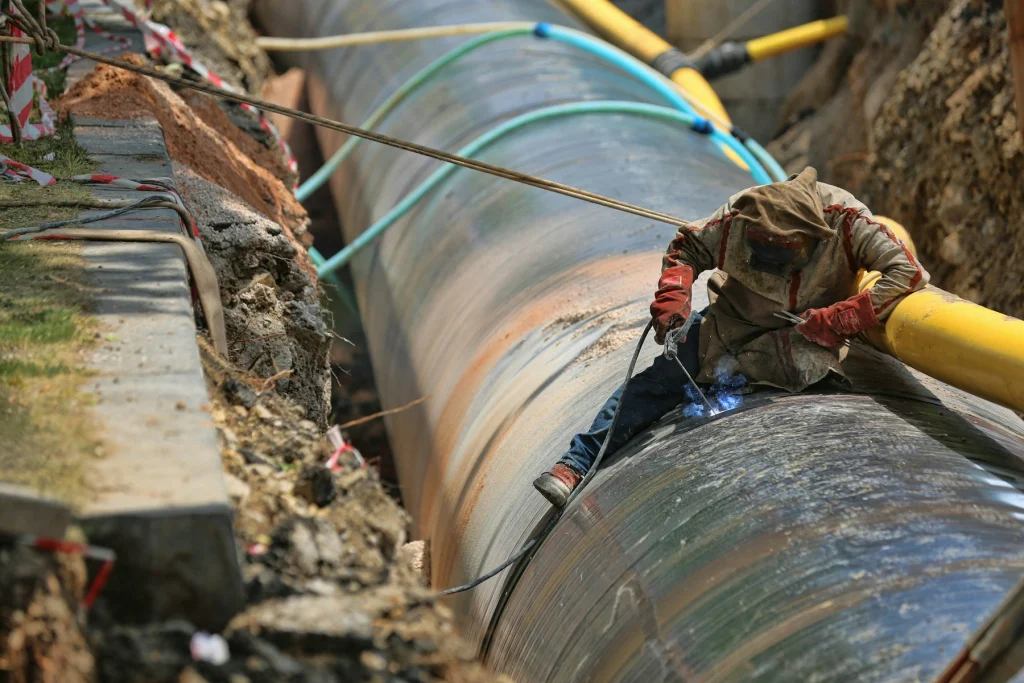
A hot work permit is a written authorization that confirms a specific location is safe for welding, cutting, grinding or other spark-producing work before it begins. It documents the fire hazards removed or protected, gas test results, the fire watch assignment and the time limits of the work. In industrial facilities, it is the core control that keeps a routine weld from starting a fire.
Hot work is a leading cause of industrial fires, and many of those incidents share the same pattern: combustibles nobody checked, a vapor source nobody tested, or a smoldering spark nobody watched for after the crew left. A permit system exists to interrupt that pattern. This guide covers what a good hot work permit includes, how it connects to other safety programs and the welding hazards that go beyond fire.
Key takeaways
- Hot work includes welding, torch cutting, air arc gouging, grinding, brazing and thermal spraying, not just welding.
- OSHA’s general industry rules in 29 CFR 1910.252 set baseline fire prevention requirements, including the commonly cited 35-foot rule and a fire watch of at least 30 minutes after work ends.
- NFPA 51B is widely adopted by insurers and fire codes, and its recent editions typically call for a longer fire watch. Check which edition applies to your site.
- Gas testing, isolation and confined space controls often need to be in place before a hot work permit can be signed.
- Fumes, radiation, electrical shock and compressed gases are serious welding hazards that a fire permit alone does not address.
What counts as hot work?
Hot work is any operation that produces flames, sparks or enough heat to ignite combustible materials or flammable atmospheres. That includes arc welding with any process, oxy-fuel cutting and brazing, plasma cutting, air carbon arc gouging, abrasive grinding and cutting, soldering, thermal spraying and the use of heat guns or torches for shrink-fitting or thawing. Some facilities also treat non-intrinsically safe electrical tools and vehicles entering a process unit as hot work.
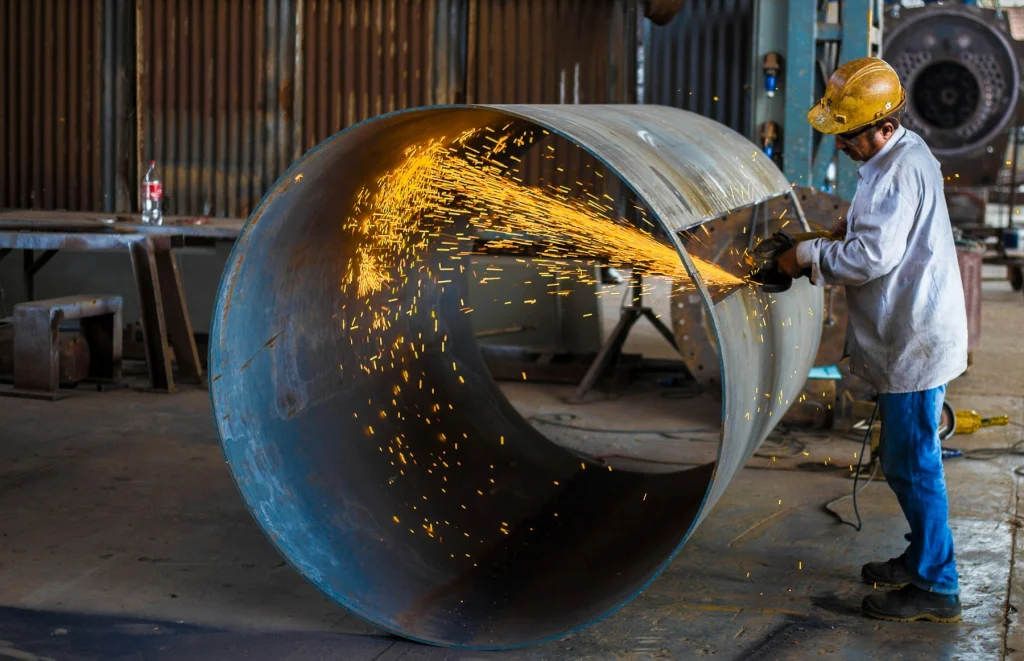
The definition matters because grinding is often underestimated. Sparks from a grinder can travel a considerable distance and remain hot enough to ignite dust, rags or vapors. A good permit program treats grinding with the same seriousness as welding.
When is a hot work permit required?
Under OSHA’s welding standards, management must establish areas and procedures for safe hot work and designate who authorizes it. Work performed in a properly designed and maintained welding shop or designated hot work area generally does not need a permit for each job. Hot work anywhere else, such as in a production area, process unit, warehouse, tank farm or rooftop, typically requires a permit.
For facilities covered by OSHA’s process safety management standard, 29 CFR 1910.119 specifically requires a hot work permit for hot work operations conducted on or near covered processes. Insurers, local fire codes and corporate standards frequently add their own requirements. Confirm the rules that apply to your facility with your safety department and the local fire marshal.
What should a hot work permit include?
Permit forms vary, but a sound hot work permit typically covers:
- The exact location and equipment, the type of hot work and a defined time window, often limited to a single shift.
- The names of the permit authorizing individual, the person performing the work and the assigned fire watch.
- Confirmation that combustibles within the required distance have been removed or protected with fire-resistant covers or shields.
- Status of floor and wall openings, cracks, ducts and conveyors that could carry sparks to other areas.
- Gas test results, test times and whether continuous monitoring is required.
- Isolation status of nearby process equipment, including lockout/tagout and blinding references.
- Fire extinguishing equipment on hand, and confirmation that sprinklers and detection systems are in service.
- Fire watch duration after work ends and any additional monitoring period.
- Signatures confirming the area was inspected before work and after the fire watch was complete.
The 35-foot rule and spark control
OSHA’s general industry standard is built around a commonly cited distance of 35 feet. If the object being welded cannot be moved to a safe location, combustibles within that radius should be relocated. If combustibles cannot be moved, they must be protected with guards, shields or fire-resistant covers. A fire watch is required when combustible materials are closer than that distance, when openings within that distance could expose combustibles in adjacent areas, or when combustibles sit on the other side of metal walls, partitions or roofs that could conduct heat.
In practice, spark control also means sealing floor grating with fire blankets, covering drains and sewers in process units where hydrocarbon vapors can collect, wetting down combustible floors where appropriate, and checking below the work area, since sparks and slag fall through gratings. Hot work at elevation on pipe racks and platforms needs particular attention to what lies underneath.
Gas testing and atmospheric monitoring
In refineries, chemical plants, tank farms and wastewater facilities, the most dangerous ignition sources are often flammable vapors that cannot be seen. Before a permit is issued, a qualified gas tester checks the atmosphere with a calibrated multi-gas meter for:
- Flammable gases and vapors, measured as a percentage of the lower explosive limit (LEL). Many facilities require a reading of zero, and others set a low threshold, often well under 10 percent of LEL, with continuous monitoring.
- Oxygen, since enriched atmospheres dramatically increase fire risk and deficient atmospheres endanger workers. OSHA treats readings below 19.5 percent or above 23.5 percent as hazardous for confined space entry.
- Toxic gases such as hydrogen sulfide or carbon monoxide, depending on the process.
Gas tests should be repeated at defined intervals and after any break in work, and continuous monitors are common where conditions can change, such as near open process equipment. Never assume yesterday’s test is still valid. Sites along the Gulf Coast petrochemical corridor, including the area around Houston, often apply some of the strictest gas testing practices.
Fire watch: duties and duration
A fire watch is a trained person whose only job is watching for fires during hot work and for a set period afterward. They should know how to use the extinguishing equipment provided, how to raise an alarm and when to stop the work. A fire watch should not also be welding, fitting or running errands.
OSHA’s general industry standard requires the fire watch to continue for at least half an hour after hot work is completed. Recent editions of NFPA 51B call for a longer post-work fire watch, commonly at least one hour, with additional monitoring at the discretion of the permit authorizing individual. Many insurers and facilities follow the longer NFPA approach. Build that time into the job plan, because crews that leave as soon as the last weld is done are a familiar contributor to after-hours fires.
Hot work in confined spaces, tanks and vessels
Welding inside tanks, vessels, columns, pits and ducts combines hot work hazards with confined space hazards. OSHA’s permit-required confined space standard, 29 CFR 1910.146 for general industry, requires evaluation, atmospheric testing, an entry permit, an attendant and rescue planning. Hot work adds more controls:
- Continuous ventilation with clean air, sized to remove welding fumes. Oxygen must never be used for ventilation.
- Compressed gas cylinders and welding machines kept outside the space.
- Torch and hose assemblies removed from the space during breaks, since a leaking hose can enrich or fill the atmosphere.
- Continuous gas monitoring, because welding itself can change the atmosphere.
- Removal or cleaning of residues, sludge and coatings that can release vapors when heated.
Never weld on an untreated container
Drums, tanks and piping that held flammable or combustible materials can explode when heated, even when they appear empty. They must be cleaned, tested and, where appropriate, purged or inerted before hot work. AWS publishes guidance on preparing containers and piping for welding and cutting, and hot tapping on live equipment follows its own specialized practices. Our tanks and vessels repair work begins with confirming that preparation is complete and documented by the facility.
Welding hazards beyond fire
A hot work permit focuses on fire and explosion. Welding safety also has to control several other serious hazards.
Fumes and gases
Welding fume composition depends on the base metal, filler, coatings and process. Stainless steel welding can generate hexavalent chromium, which OSHA regulates under a specific standard with a low exposure limit. Manganese, nickel, and zinc from galvanized coatings, along with lead or cadmium from old paint, also pose health risks. Controls include local exhaust ventilation, fume extraction guns, removing coatings before welding and respiratory protection where exposure assessments call for it.
Arc radiation and eye injury
Welding arcs emit intense ultraviolet and infrared radiation. Welders need helmets with the correct filter shade for the process and current, and nearby workers need protection from flash through welding screens or curtains. ANSI Z49.1 and OSHA provide shade selection guidance.
Electrical shock
Wet conditions, damaged leads, poor grounding and working inside conductive enclosures all raise shock risk. Inspect cables, electrode holders and connections daily, keep work and gloves dry and use equipment with voltage-reducing features for confined or damp locations.
Compressed gases
Cylinders should be secured upright, capped when not in use and stored away from heat. OSHA requires oxygen cylinders in storage to be separated from fuel gas cylinders by a minimum distance or by a fire-resistant barrier. Flashback arrestors on oxy-fuel equipment and regular leak checks reduce the risk of hose fires.
Heat stress and burns
Welding in summer heat, inside enclosures or near hot process equipment can push workers into heat illness. Flame-resistant clothing, leather gloves and boots protect against burns from spatter and slag, and many petrochemical sites require flame-resistant garments for all personnel in process areas.
Reducing hot work when possible
The safest hot work is the hot work you do not need to perform in a hazardous area. Before issuing a permit, ask whether the work can be moved or changed:
- Fabricate assemblies in the shop and install them with bolted connections or minimal field welds. Our pipe welding team prefabricates spools so field joints are limited to tie-ins.
- Use cold cutting methods such as saws, pipe cutters and hydraulic splitters instead of torches near process equipment.
- Schedule hot work during shutdowns, when units are isolated, purged and easier to make safe, as discussed in our guide to planning a plant shutdown.
- Use pressurized welding enclosures, sometimes called habitats, where hot work must proceed near operating equipment.
Pre-work hot work safety checklist
- Confirm the work cannot be done in a designated hot work area or with cold methods.
- Walk the site with the permit authorizing individual and the crew.
- Remove or protect combustibles within the required distance, including below and behind the work.
- Cover openings, drains, gratings and ducts that could carry sparks.
- Verify isolation, lockout/tagout and blinding of nearby process equipment.
- Complete gas testing and set the retest interval or continuous monitoring.
- Confirm confined space permits, ventilation and rescue plans where applicable.
- Stage fire extinguishers or hose lines and assign a trained fire watch.
- Check welding equipment, leads, cylinders, regulators and flashback arrestors.
- Confirm fume controls and PPE for the materials being welded.
- Agree on the post-work fire watch duration and final sign-off.
Frequently asked questions
Who can sign a hot work permit?
The facility designates the person, often called the permit authorizing individual. They are typically a trained supervisor, operator or safety representative who knows the area’s hazards and has authority to stop work. The contractor performing the hot work usually signs to acknowledge the conditions. Facilities should document training for anyone authorized to issue permits.
How long is a hot work permit valid?
Validity is set by facility policy, and many limit permits to a single shift or a specific time window. Permits generally become invalid if conditions change, such as a process upset, a gas alarm, a change in work scope or a break longer than allowed. When conditions change, the area should be re-evaluated and a new permit issued.
Does grinding require a hot work permit?
In most industrial facilities, yes. Abrasive grinding and cutting throw sparks that can ignite combustibles and flammable vapors, so they are generally treated as hot work. Some facilities differentiate low-energy tools, but grinding near process equipment, combustible dust or stored materials typically requires the same controls as welding.
Can the welder also act as the fire watch?
Generally, no. The fire watch is meant to have no other duties during the work, because a welder under a helmet cannot see sparks landing behind them or below a grating. After the work, the fire watch must remain for the required period, which a welder moving to the next job cannot do.
What is the difference between OSHA rules and NFPA 51B?
OSHA standards are federal workplace safety regulations. NFPA 51B is a consensus standard for fire prevention during hot work, adopted through fire codes, insurance requirements and company policy. They overlap heavily, but NFPA 51B tends to be more detailed and, in recent editions, calls for a longer fire watch. Many facilities follow whichever is stricter.
Safe hot work is planned hot work
Hot work permits work best when the welding contractor treats them as part of the job plan rather than paperwork to get through. Industrial Welding plans permit time, fire watch and gas testing into every plant maintenance scope and works within each facility’s own permit system. Send your scope, site requirements and schedule through the Get a Quote form, and we will return a free written quote that accounts for the safety steps your facility requires.