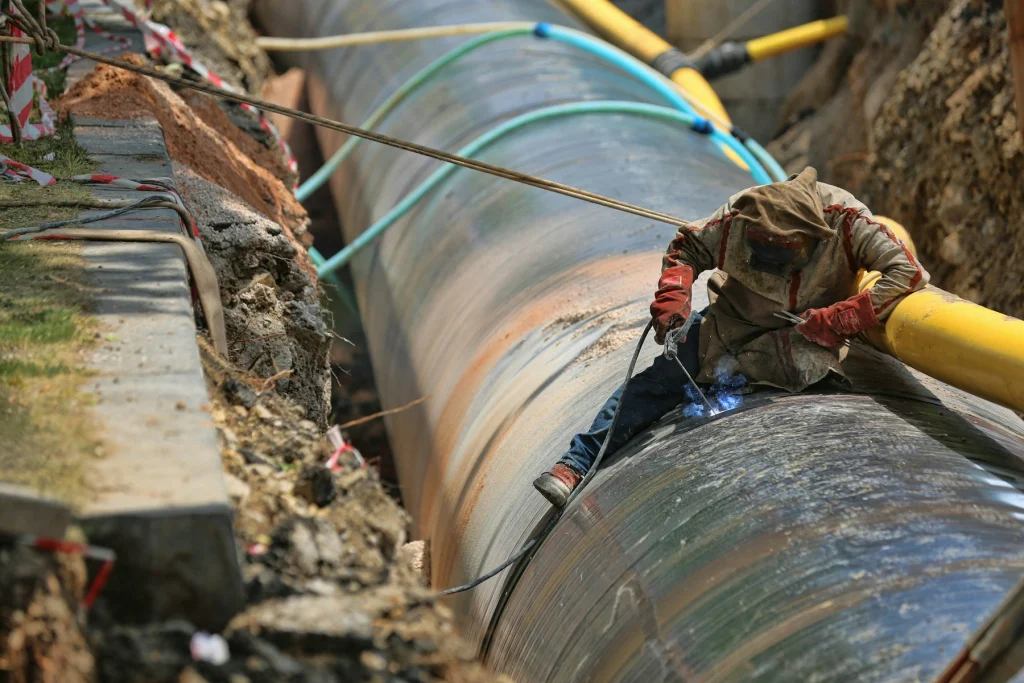

A welding procedure specification (WPS) is the written recipe a welder follows to make a code-compliant joint: process, base metal, filler, position, preheat, amperage range and more. A procedure qualification record (PQR) is the lab-tested proof that the recipe produces sound, strong welds. Plant managers need both on file before critical welding starts, plus a qualification record for each welder.
Most plant managers do not need to read a WPS line by line. You do need to know what the paperwork is supposed to prove, which documents belong together, and the handful of questions that expose a contractor who is welding without real procedures. This guide covers that ground from the owner’s side of the table, not the welding engineer’s.
Key takeaways
- A WPS tells the welder how to weld; a PQR proves that the WPS works; a welder performance qualification (WPQ) proves that a specific person can execute it.
- Every WPS used on code work should reference the PQR or PQRs that support it, unless the governing code allows prequalified procedures.
- Essential variables are the settings that cannot change without requalifying the procedure. Most procedure problems trace back to an essential variable drifting outside its range.
- The construction code (for example AWS D1.1, ASME B31.3 or ASME Section VIII) decides which qualification rules apply and how welds are inspected.
- Ask for the WPS, PQR and welder qualifications before mobilization, not after the first weld fails inspection.
What is a welding procedure specification?
A welding procedure specification is a controlled document that defines the conditions for making a particular type of weld. It lists the welding process (SMAW, GTAW, GMAW, FCAW or SAW), the base metal groups it covers, the thickness and diameter ranges, filler metal classifications, shielding gas, joint design, positions, preheat and interpass temperatures, post-weld heat treatment and electrical characteristics such as current type, polarity and amperage range.
Think of it as the boundary of a qualified envelope. As long as the welder stays inside those limits, the weld is expected to have the mechanical properties the procedure test demonstrated. Step outside them, and the weld may still look fine on the surface while hiding lack of fusion, hydrogen cracking or a heat-affected zone that has lost toughness.
What a WPS is not
A WPS is not a drawing and it is not an inspection plan. The drawing says where the weld goes and how big it is. The inspection and test plan says how the finished weld is checked. The WPS sits between them and controls how the metal is actually joined. Confusing these roles is one of the most common reasons owners think they have “the welding paperwork” when they only have one third of it.
What does a PQR prove, and how is it created?
A procedure qualification record documents an actual test weld. The contractor welds a coupon using specific, recorded values for every variable: the exact base metal heat, filler lot, amperage, voltage, travel speed, preheat and so on. That coupon then goes through destructive testing. Under ASME Section IX, procedure qualification on groove welds typically involves tension tests and guided bend tests; when the construction code requires notch toughness, impact testing is added. AWS D1.1 has its own test requirements, which can include macroetch examination and other tests depending on the joint.
The PQR records what happened, not what is allowed. That distinction matters. The PQR shows, for example, that a 3/4-inch carbon steel plate was welded with E7018 at a measured amperage and passed its bend tests. The WPS then uses the code’s rules to translate that single test into a range: thickness limits, positions and other variables that the test qualifies.
Why PQRs are expensive and why that is a good sign
Qualifying a procedure means material, welding time, machining test specimens and paying an independent testing laboratory. A contractor with a library of PQRs covering carbon steel, stainless and common dissimilar combinations has invested real money in that capability. A contractor who produces a WPS with no PQR behind it, on work where the code requires one, has skipped that investment, and the risk lands on your equipment.
How do welder qualifications fit with the WPS?
A qualified procedure does not mean every welder can execute it. Each welder or welding operator must also pass a performance test, documented on a welder performance qualification record, sometimes called a WPQ or welder qualification test record. The welder makes a test weld following a qualified WPS, and the coupon is evaluated by bend testing or, where the code allows, by radiography.
The test qualifies the welder for a range of positions, thicknesses, diameters, filler metal groups and processes. A welder who tested in the flat position on plate is not automatically qualified for an overhead pipe weld. Under both AWS D1.1 and ASME Section IX, qualifications typically lapse if the welder goes about six months without using the process, unless continuity is documented. Confirm the exact rule in the edition of the code your project uses.
The continuity log
Ask the contractor how they track welder continuity. A disciplined shop keeps a log showing each welder’s processes and the dates they last used them on qualified work. Without that log, a welder’s two-year-old test record proves very little about whether they are qualified today.
Essential, supplementary and nonessential variables
Every welding code sorts procedure variables into categories. The terms below follow ASME Section IX; AWS D1.1 uses similar logic with its own tables and limits.
- Essential variables: changes that affect mechanical properties. Changing base metal group (P-Number), increasing thickness beyond the qualified range, changing the process, or dropping preheat below the qualified minimum typically requires a new PQR.
- Supplementary essential variables: these become essential only when the construction code requires impact (toughness) testing. Heat input is the classic example, which is why low-temperature service often brings tighter limits on amperage and travel speed.
- Nonessential variables: details such as groove design or certain technique items, which can be changed by revising the WPS without new testing.
For a plant manager, the practical lesson is that some field changes are paperwork and some are not. If a crew wants to switch from stick to flux-cored on a pressure line to speed things up, that is not a casual change. It needs a different, qualified procedure and qualified welders for that process.
Prequalified procedures under AWS D1.1
AWS D1.1, the structural welding code for steel, allows prequalified WPSs. If every condition the code lists is met, including approved base metals, matching filler metals, prescribed joint geometries, minimum preheat and process limits, the WPS can be used without a PQR. This is a significant difference from ASME Section IX, which generally requires procedures to be qualified by test. ASME does permit certain AWS standard welding procedure specifications to be adopted under specific rules, which is another reason to read the code text rather than rely on habit.
Prequalification is not a loophole. The prequalified WPS still has to be written down, and the welders still need qualification. If any condition falls outside the prequalified limits, such as a joint detail that is not in the prequalified figures or a steel that is not on the approved list, the procedure must be qualified by test. Our article on AWS D1.1 vs ASME Section IX walks through where those two codes split.
Which code governs your weld?
The WPS answers “how” but not “which rules”. That comes from the construction code tied to the equipment or structure. Common examples in industrial plants include:
- AWS D1.1 for structural steel: platforms, pipe racks, mezzanines, equipment supports and similar structural steel work.
- ASME B31.3 for process piping in chemical plants, refineries and similar facilities, with welding qualified under ASME Section IX.
- ASME B31.1 for power piping, also referencing Section IX for qualification.
- ASME Section VIII for pressure vessels, with repairs to stamped vessels governed by jurisdictional requirements such as the National Board Inspection Code.
- API 1104 for pipelines, which has its own procedure and welder qualification rules.
Your engineering department, insurer or authorized inspector should confirm which code applies. On mixed scopes, like a shutdown that touches piping, supports and a vessel nozzle, the contractor may need several WPSs under different codes for the same week of work. That is normal and worth planning for, as we cover in our guide to planning welding scope for a plant shutdown.
Red flags when reviewing a contractor’s procedures
You do not need a welding engineer on staff to catch the most common problems. Look for these warning signs:
- The WPS has no PQR number listed, and the work is under a code that requires qualified procedures.
- The WPS lists a thickness range or position that the supporting PQR could not qualify. For instance, a thin test coupon supporting a WPS for very heavy wall.
- Generic WPSs with the company name pasted on and no signature, revision level or date.
- Welder qualifications that do not match the process or position on the WPS, or that have no continuity records.
- A PQR with test results but no lab report, or a lab report for a different material than the one being welded.
- Procedures for carbon steel being used on chrome-moly or stainless without a separate qualified WPS.
- No mention of preheat, interpass control or post-weld heat treatment on alloys where those controls clearly matter.
None of these automatically means bad welding. Each one means you should ask a follow-up question before work proceeds.
How procedures change the cost and schedule of a job
Procedure requirements shape both price and timing. If the contractor already holds qualified procedures for your material, thickness and process, the job can mobilize quickly. If a new PQR is needed, add time for welding the coupon, machining specimens and lab turnaround, which can stretch from days to a few weeks depending on the lab’s backlog and whether impact testing is required.
Material traceability also affects cost. Code work usually requires mill test reports for base metal and certificates of conformance for filler metal, and some owners require heat-number tracking on every spool. Post-weld heat treatment, hardness testing and nondestructive examination each add steps. When you compare quotes, check whether each contractor priced the same documentation package. A lower number sometimes reflects a thinner paper trail rather than more efficient welding. Our pipe welding scopes, for example, list the documentation deliverables alongside the welding itself so those differences are visible.
A practical checklist before welding starts
Use this list during contractor prequalification or at the kickoff meeting for any code welding job:
- Identify the governing construction code and edition for each part of the scope.
- Request the WPS for each joint type, material combination and process that will be used.
- Confirm each WPS lists its supporting PQR, or states that it is prequalified under AWS D1.1 where allowed.
- Request copies of the PQRs and the testing laboratory reports behind them.
- Request welder performance qualification records for every welder assigned, plus continuity logs.
- Check that welder qualifications cover the processes, positions and thickness ranges on the WPSs.
- Agree on preheat, interpass and post-weld heat treatment methods and how they will be recorded.
- Agree on material traceability: mill test reports, filler certificates and heat-number marking.
- Confirm the inspection and NDE plan, including who performs it and the acceptance criteria. See our overview of weld inspection methods.
- Decide who keeps the final weld records and in what format, so the data book is complete at handover.
Frequently asked questions
Can a contractor use our plant’s existing WPSs?
Generally, no. Under ASME Section IX, the organization responsible for the welding must qualify its own procedures and maintain its own PQRs, with limited exceptions such as adopting certain AWS standard welding procedure specifications. A contractor can follow your engineering standards and preferred filler metals, but the WPS and PQR used on your job typically need to be theirs. Confirm the rule in the code edition your project uses.
How long is a WPS valid?
A qualified WPS does not expire on a calendar basis. It remains valid as long as the supporting PQR stands and the code rules behind it have not changed in a way that affects it. Welder qualifications are different: they typically lapse after about six months without using the process unless continuity is documented. Contractors should review procedures when a new code edition is adopted.
Does a certified welder mean the weld is code compliant?
Not by itself. A welder certification shows the person passed a test under specific conditions. Code compliance also depends on following a qualified WPS for the joint, using the correct materials, completing the required inspection and documenting all of it. A skilled welder working without a qualified procedure, or outside its limits, can still produce non-compliant work.
Who should review WPSs on our side?
For pressure equipment, your authorized inspector or mechanical integrity group usually reviews procedures. For structural work, the engineer of record or a Certified Welding Inspector often handles it. If you lack in-house expertise, a third-party inspector can review the WPS, PQR and welder records before mobilization for a modest cost compared with the price of rework.
What happens if a weld is made outside the WPS?
The weld is typically treated as nonconforming, even if it looks acceptable. Depending on the code and your quality program, it may need engineering evaluation, additional NDE or removal and re-welding under a qualified procedure. Catching the deviation early, through in-process checks of preheat, amperage and filler metal, is far cheaper than finding it during final inspection.
Getting procedures right from the first weld
Good welding paperwork is not bureaucracy for its own sake. It is the evidence that the welds holding your process piping, platforms and vessel attachments will perform the way the design assumed. When you request a quote from Industrial Welding, tell us the governing code, materials and thicknesses, and we will state which qualified procedures apply to your scope and what documentation you receive at handover. Use the Get a Quote form to send drawings, specifications or photos, and we will return a free written quote. You can also read more about how we approach industrial work before you reach out.